
Here's what nobody tells you about ED and pleasure
Erectile dysfunction shows up, and suddenly the entire architecture of your sex life feels wrong. One person feels broken. The other feels rejected. Both of you are thinking about the one thing that isn't happening, which makes it even less likely to happen. It's a cycle, and it's painful.
But here's what I've learned working with couples through this: ED is actually an opportunity to rebuild intimacy in a way that serves both of you better than what came before.
Why lemon clitoral vibrators change the game
The moment you introduce a lemon vibrator into the equation, something shifts. Suddenly the focus isn't on one person's body or one body part's performance. It's on mutual pleasure. It's collaborative. It's about building arousal and sensation together, which takes the pressure completely off penetration.
Lemon vibrators work particularly well because they're intentional. They're not a Band-Aid on the problem. They're a full reframing of what sex is supposed to look like. When penetration isn't the default or the goal, people often discover that clitoral orgasms are actually more reliable, more intense, and more pleasurable for everyone involved. That's not consolation. That's an upgrade.
The suction mechanism of a lemon vibrator also means your partner can be involved in a way that isn't dependent on their erection. They can hold the lemon vibrator, control the patterns, feel you respond to it. That's intimacy. That's participation without performance pressure.
The conversation that matters before you even touch it
Don't surprise your partner with a lemon vibrator. Honestly, don't surprise anyone with a vibrator, but especially not when ED is in the room. ED already carries shame and anxiety. Introducing a sex toy without context reads as criticism, even when that's not what you intend.
Instead, have this conversation while you're both clothed, not in bed, and not when either of you is trying to initiate sex. Say something like: "I've been thinking about how we could have more fun together. ED doesn't mean we can't enjoy each other. I'd love to try something that might take the pressure off both of us." Then ask if they'd be willing to explore it.
Show them what a lemon vibrator actually looks like. Let them hold it. Explain how it works. Answer questions. Make it normal. The more familiar it becomes before you use it, the less threat it carries.
How to actually use it together
Start with all your clothes on. Seriously. Sit next to each other, maybe with a glass of water nearby, and just talk about it. Your partner can hold the lemon vibrator. They can feel how it vibrates. They can see the patterns and intensity levels. This isn't foreplay yet. It's just getting comfortable.
When you're both ready to move forward, you don't need to jump to full nudity. You might start with you wearing underwear or a skirt, and your partner using the lemon vibrator through the fabric. This buys you time to stay aroused without the pressure of seeing or being seen fully. Many couples find this is actually hotter anyway.
As you get more comfortable, your partner can apply the lemon vibrator directly. The beauty here is they're not thinking about their own arousal or their own body. They're focused entirely on you. On your breathing. On what patterns make you respond. This is foreplay, actual connection, and it doesn't require any specific physical response from them.
Let your partner take their time with it. There's no rush. If they want to use one pattern for five minutes, that's fine. If they want to switch every thirty seconds, that's fine too. The pressure is off because nothing else has to happen. You can come or not come. They can get hard or not get hard. The pleasure is the point, not the outcome.
What happens when ED is situational or stress-related
A lot of ED is actually performance anxiety dressed up as a physical problem. Which doesn't mean it's not real, it just means the root cause is psychological. When you use a lemon vibrator and you're both oriented toward a different kind of pleasure, that anxiety often evaporates. Your partner isn't watching themselves. They're watching you. That's a completely different nervous system state.
If ED is situational (stress from work, money, family stuff), sometimes just shifting the sexual dynamic helps things resolve naturally over time. The couple I worked with who introduced a lemon vibrator specifically for this reason reported that within three months, penetrative sex became possible again because the performance pressure had lifted.
If ED is more persistent, you might also benefit from a conversation with your partner's doctor. ED can be a sign of cardiovascular issues or hormonal changes. It's not failure to address it medically if that's appropriate. But even if your partner is on medication or working with a provider, a lemon vibrator still changes the emotional tenor of your sex life in a way that's healing.
When using it becomes part of your routine
Some couples integrate a lemon vibrator and never go back to penetration as the main event. Some use it sometimes. Some find that as the anxiety decreases, they're able to have penetrative sex again and they use the vibrator alongside it. All of these are completely fine.
What I see most often is that couples report feeling closer, less resentful, and less burdened. Because the pressure is off. Because you're collaborating instead of performing. Because pleasure is actually about mutual satisfaction, not about one person's body working correctly.
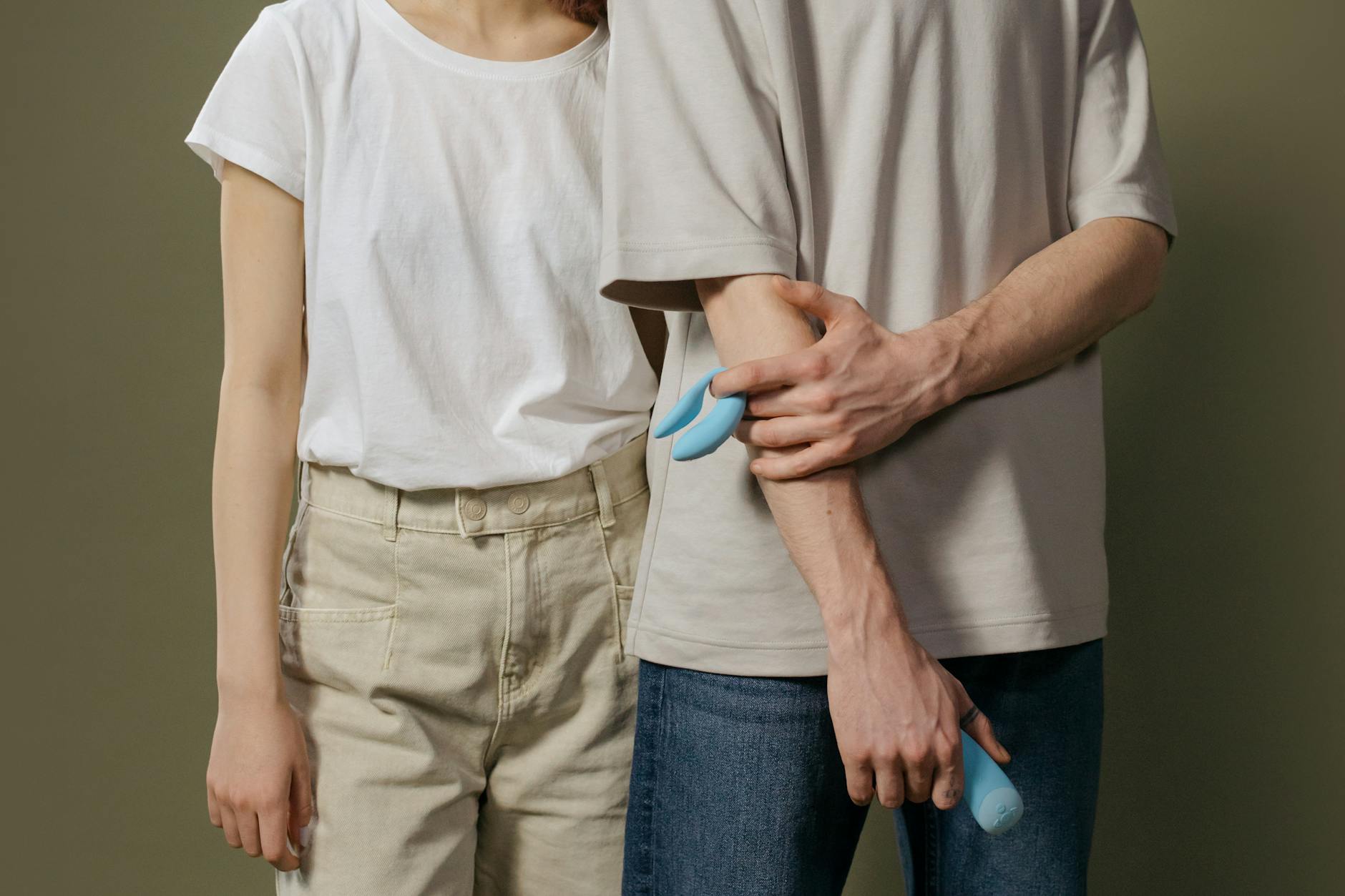
Photo by cottonbro studio on Pexels
The emotional work that happens alongside the vibrator
If you're the partner without ED, you might be carrying anger, disappointment, or feeling unseen. That's valid. And it's also important to separate that from your partner's body. Your partner is not rejecting you. Their body is responding to stress, medication, age, or health stuff. Being able to say that distinction out loud can be revolutionary.
If you're the partner with ED, you might be feeling shame, failure, or anxiety about being a "real man" or being enough. That's also valid. And using a lemon vibrator together can actually help you remember that you're more than one body part. That you can give pleasure in other ways. That sex isn't about your penis performing on command. It's about intimacy.
Both of these emotional pieces matter as much as the physical tool. The lemon vibrator is helpful, but the real work is agreeing that you're a team, that pleasure is mutual, and that this is fixable.
When to loop in professional support
If ED is completely derailing your relationship, or if you can't talk about it without one of you getting defensive or withdrawn, a sex-positive therapist can help. They can facilitate the conversation in a way that doesn't carry all the historical tension. I've seen couples go to one or two sessions just to learn how to talk about this without it becoming a referendum on their relationship.
Also, if you're using a lemon vibrator and still feeling disconnected, that's information too. Sometimes ED is a symptom of a bigger relationship rupture. A vibrator can't fix that, but a therapist can.
The long-term shift
Many couples tell me that introducing a lemon vibrator was the best thing they did for their sex life, not because it fixed ED, but because it forced them to reimagine what sex actually is. It became less goal-oriented. More collaborative. More focused on sensation and connection than on performance.
Your pleasure matters. Your partner's pleasure matters. And neither of those things are dependent on one specific body part working in one specific way. A lemon vibrator helps you remember that.
FAQ: Erectile dysfunction and lemon vibrators
How do I bring up using a lemon vibrator if my partner is already feeling insecure about ED?
Frame it as something that helps both of you, not as a workaround for his problem. Try: "I want us to have more fun together, and I think trying something new could help us both feel less pressure." Emphasize pleasure, not fixing. And do this conversation clothed, not in a moment of sexual tension.
Will using a lemon vibrator make ED worse or become a crutch?
The opposite is usually true. When the pressure to perform comes off, erectile function often improves naturally. And even if it doesn't, you're building a sex life that doesn't depend on it. That's not a crutch, that's resilience.
Can my partner use a lemon vibrator on me if they can't get erect?
Absolutely. In fact, this is one of the most powerful uses of a lemon vibrator. Your partner can be fully engaged, can experience your pleasure, can feel like an active participant. All without their body needing to do anything specific.
What if my partner refuses to try a lemon vibrator because they see it as emasculating?
That's a deeper conversation about what masculinity means to him, and it's one worth having. But you might also reframe it: Using a lemon vibrator is confident. It's collaborative. It's about prioritizing your mutual pleasure over rigid ideas about how sex "should" look. Sometimes letting your partner hear from other men (a therapist, a close friend, even articles) that this isn't weakness can help shift perspective.
How long should we wait before trying a lemon vibrator if ED just started?
There's no timeline. Give yourself a few conversations first. Let your partner get comfortable with the idea. Some couples move fast, some take weeks. The rush isn't the point. Feeling safe and connected is.
Is ED always permanent, or can a lemon vibrator help it resolve?
That depends on the cause. If ED is situational (stress, anxiety, relationship tension), shifting to a more pleasure-focused, less performance-focused dynamic can actually help resolve it. If it's medical, a vibrator is helpful but your partner might also need to see a doctor. Both things can be true.
One more thing
ED shows up in roughly 40 percent of men in their 40s, and the numbers climb from there. It's not rare. It's not a referendum on your relationship or your partner's manhood. It's a shift that requires a different approach to pleasure. A lemon vibrator isn't a Band-Aid. It's actually an invitation to build something better.